
Missing teeth can affect the way you eat, speak and feel about your smile, and may allow nearby teeth to shift over time. At Delacombe Family Dental, we provide dental implant consultations for patients in Ballarat, Delacombe and surrounding suburbs.
A dental implant is one option for replacing one or more missing teeth. Before recommending treatment, our dentists will assess your jawbone, gums and overall oral health to determine whether an implant or another missing-tooth replacement option, such as a dental bridge, may be suitable for you.
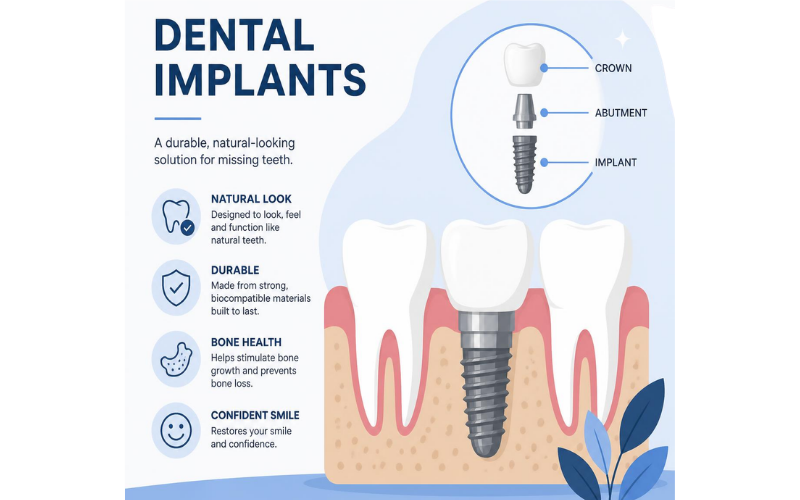
A dental implant is a small titanium post that is surgically placed into the jawbone to act as an artificial tooth root. Over time, the implant may fuse with the surrounding bone through a process called osseointegration, creating a stable base for a replacement tooth.
Once healed, a custom-made crown, bridge or denture can be attached to the implant. Unlike a removable denture, an implant-supported restoration is fixed in place and is not taken out at home.
Implants may be considered for patients who have lost one or more teeth due to decay, gum disease, injury or other causes. Suitability depends on individual factors such as bone density, gum health and general health, which your dentist will assess during your consultation.
Replacing a missing tooth may help restore chewing function, support clearer speech and improve the appearance of your smile. An implant may also help preserve the surrounding jawbone, which can otherwise gradually reduce in density after a tooth is lost.
Left untreated, a gap may allow neighbouring teeth to tilt or drift into the space, and the opposing tooth may also shift due to a lack of normal biting contact.
Not every patient or every missing tooth requires an implant. Your dentist will explain the potential benefits, limitations and alternatives based on your specific circumstances.
The right restoration depends on how many teeth are missing and your individual treatment goals.
Single implant with a crown – used to replace one missing tooth without affecting the neighbouring teeth.
Implant-supported bridge – used to replace several missing teeth in a row, supported by two or more implants rather than natural teeth.
Implant-supported denture – used to stabilise a full or partial denture, which may improve comfort and retention compared with a conventional removable denture.
Your dentist will discuss which option may be appropriate after assessing your bone structure, remaining teeth and overall treatment needs.
Suitability depends on the condition of your jawbone, gums and general health.
Before recommending treatment, your dentist will typically assess:
Patients with insufficient bone volume may still be candidates for implants following a bone grafting procedure. Your dentist will explain whether this applies to your situation.
Your initial consultation at Delacombe Family Dental may include a clinical examination, dental X-rays and, in some cases, 3D imaging to assess the jawbone in detail.
Your dentist will discuss:
We will also discuss your preferences and treatment goals so you can make an informed decision. Patients visiting the practice for the first time can read our new patient information before attending.
Assessment and planning – Your dentist reviews your X-rays and, where used, 3D scans to plan the position and angle of the implant.
Implant placement – The implant post is placed into the jawbone under local anaesthesia. Some patients may require additional procedures, such as bone grafting, before or during this stage.
Healing and integration – Over a period of months, the implant integrates with the surrounding bone. Healing times vary between patients.
Restoration – Once healing is confirmed, a custom-made crown, bridge or denture is attached to the implant to complete the restoration.
The number of appointments and overall treatment time will depend on your individual case, including whether any additional procedures are required.
A dental implant is one of several ways to replace a missing tooth.
A dental bridge is a fixed restoration supported by the natural teeth on either side of the gap, or in some cases by implants. It does not require surgery but usually involves preparing the neighbouring teeth.
A removable denture can replace one or more missing teeth without surgery, but must be taken out for cleaning and may feel less stable than a fixed restoration.
An implant is placed directly into the jawbone and does not rely on the neighbouring teeth for support. It requires a surgical procedure and depends on factors such as bone availability and general health.
Your dentist will explain the advantages, limitations, treatment timeframes and costs of each option so you can decide what suits you.
Good oral hygiene is important for the long-term success of an implant.
Recommended care typically includes:
The gum and bone around an implant can still be affected by inflammation or infection if not cleaned properly, so ongoing maintenance is important.
The lifespan of an implant varies depending on factors such as oral hygiene, gum health, bone quality, grinding or clenching habits, general health and regular dental care.
With appropriate care and regular monitoring, implants may last many years. However, no dental restoration lasts indefinitely, and the crown, bridge or denture attached to the implant may eventually need adjustment, repair or replacement.
Regular examinations allow your dentist to monitor the implant, surrounding gum and bone, and the attached restoration.
The cost of dental implants in Ballarat can vary depending on the number of implants required, whether bone grafting or other preparatory treatment is needed, and the type of restoration selected (crown, bridge or denture).
After your assessment, your dentist can provide a personalised treatment plan and cost estimate. Information about our available payment plan options is also available on our website.
Private health fund benefits differ between policies, providers and annual limits. Contact your insurer directly to check what may be covered for implant treatment.
Delacombe Family Dental provides personalised restorative care for patients considering dental implants. Our team assesses your oral health, explains suitable options and helps you understand what each stage of treatment may involve.
We welcome patients from Ballarat, Delacombe, Alfredton, Lucas, Sebastopol, Wendouree and surrounding areas.
Most patients experience only mild discomfort during and after implant placement, as local anaesthetic is used during the procedure. Any post-operative soreness can usually be managed as advised by your dentist.
Lifespan varies between patients, but with good oral hygiene, healthy gums and regular dental check-ups, implants may last many years. Your dentist can discuss what to expect based on your individual circumstances.
Suitability depends on factors such as bone density, gum health and general health. Your dentist will assess your jawbone and discuss whether additional procedures, such as bone grafting, may be needed.
Cost depends on the number of implants required, the type of restoration and whether preparatory treatment such as bone grafting is needed. A personalised estimate is provided after your assessment.
Dental implants are a well-established treatment option. As with any surgical procedure, outcomes depend on individual health factors, which your dentist will assess before recommending treatment.
If you are considering dental implants, book an appointment online with Delacombe Family Dental.
You can also contact our dental practice to arrange a consultation. Our team can assess your suitability, discuss the available restoration options and help you make an informed decision about your care.
At Delacombe Family Dental, we do our utmost to cater to the needs of our patients. We make every effort to accommodate your preferred appointment time. Feel free to contact us with any questions or to check availability. Your convenience and satisfaction are our top priorities.


Ready to book? Contact Delacombe Family Dental on (03) 5312 7815 or book online. We serve patients across Delacombe, Alfredton, Sebastopol, Wendouree, Lucas and the wider Ballarat area.
Tue: 9 am – 7 pm
Wed: 9 am – 6 pm
Thu: 9 am – 5 pm
Fri: 9 am – 5 pm
Sat: Closed
Sun: Closed
Promotion Terms: Please note that any promotions or offers available through our websites cannot be combined with other promotions or discounts and are non-convertible into cash. These promotions are subject to change and may be amended or withdrawn at our discretion without prior notice. They are valid only during the advertised dates and are available only while supplies last. Eligibility for any promotion is subject to conditions as stated in specific promotional materials. We reserve the right to modify the terms of these promotions or to cancel them entirely at any time and without prior notice. We shall not be liable for any loss or damage of whatever nature (direct, indirect, consequential, or other) that may result from the modification, cancellation, or failure of any promotion.