
A damaged, cracked or weakened tooth can affect your comfort, confidence and ability to chew properly. At Delacombe Family Dental, we provide personalised dental crown consultations for patients in Ballarat, Delacombe and surrounding suburbs.
A dental crown may be recommended when a tooth has lost a significant amount of its natural structure or needs additional protection. Before recommending treatment, our dentists will assess the tooth, surrounding gums and your overall bite to determine whether a crown is suitable for your individual needs.
Patients with urgent pain, swelling or a broken tooth may also need an emergency dental appointment before restorative treatment can be planned.
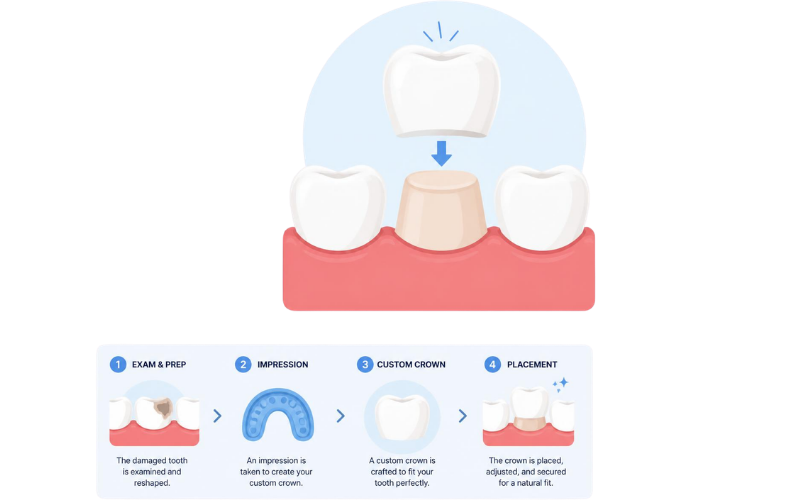
A dental crown is a custom-made restoration that covers the visible part of an existing tooth. It is sometimes referred to as a cap because it fits over the prepared tooth to help restore its shape, strength and function.
Crowns may be used to protect teeth that have been weakened by decay, large fillings, fractures, wear or previous dental treatment. They can also be designed to improve the appearance of a tooth when appropriate.
The type of restoration recommended will depend on the location of the tooth, the amount of healthy tooth structure remaining and the pressure placed on it when you bite.
For smaller areas of damage or decay, a dental filling may be more suitable.
Your dentist may discuss a crown if a tooth is cracked, heavily filled, worn down or significantly affected by decay. A crown may also be considered after root canal treatment when the tooth needs additional protection.
Other reasons a crown may be recommended include:
A crown is not necessary for every damaged tooth. In some cases, a filling, onlay, veneer or another treatment may be more suitable. Your dentist will explain the available options after examining the tooth.
Patients interested mainly in changing the appearance of front teeth may also wish to learn about dental veneers or other cosmetic dental treatments.
Dental crowns can be made from different materials, including porcelain, ceramic, zirconia, metal alloys or a combination of materials.
The most suitable material will depend on several factors, including:
For visible teeth, appearance may be an important consideration. For back teeth, durability and resistance to chewing pressure may be prioritised.
Your dentist will explain which materials are available and discuss the benefits and limitations of each option.
Your appointment at Delacombe Family Dental will usually begin with an examination of the affected tooth and surrounding tissues. Dental X-rays may be recommended to check the roots, supporting bone and areas that cannot be seen during a visual examination.
If a crown is appropriate, your dentist will explain:
You will have an opportunity to ask questions before deciding whether to proceed. New patients can review our first-visit information before their appointment.
The tooth is usually prepared so the crown can fit securely over it. Local anaesthetic may be used to help keep you comfortable during the procedure.
A digital scan or physical impression may then be taken to record the shape of the prepared tooth, the neighbouring teeth and your bite. This information is used to create a custom restoration.
Depending on the treatment process, a temporary crown may be placed while the final restoration is being made. At the fitting appointment, your dentist will check the crown’s shape, contact points, appearance and bite before securing it in place.
The number of appointments required can vary depending on the tooth, restoration type and individual treatment plan.
A crowned tooth still needs regular cleaning and professional dental care. While the crown itself cannot develop tooth decay, the natural tooth underneath and around its edges can still be affected.
To care for your restoration:
Ongoing general dental care helps your dentist monitor the restoration, gums and remaining natural tooth structure.
Contact the practice if your crown feels loose, breaks, becomes uncomfortable or changes the way your teeth meet.
The lifespan of a crown varies from person to person. Factors such as oral hygiene, biting pressure, tooth grinding, diet, crown material and regular dental care can all affect how long the restoration lasts.
Routine check-ups allow your dentist to monitor the crown, the tooth underneath it and the surrounding gums. Good home care can also help protect the restoration and supporting tooth.
No dental restoration lasts forever, and repair or replacement may eventually be required.
The cost of treatment can vary depending on the condition of the tooth, the material used and whether additional dental care is required.
After examining the tooth, your dentist can provide a personalised treatment plan and cost estimate. You can also learn more about available payment plan options.
Private health fund benefits vary between policies, annual limits and treatment categories. Contact your insurer directly if you would like to confirm your expected benefit.
Delacombe Family Dental provides restorative care in a supportive and patient-focused environment. Our team takes the time to assess the condition of your tooth, explain suitable options and help you understand the expected treatment process.
We welcome patients from Ballarat, Delacombe, Alfredton, Lucas, Sebastopol, Wendouree and surrounding communities.
If you have a cracked, worn or heavily filled tooth, book an appointment online with Delacombe Family Dental.
You can also contact our Delacombe practice to arrange a consultation. Our team can assess the tooth, discuss suitable restorative options and help you plan your next step with confidence.
At Delacombe Family Dental, we do our utmost to cater to the needs of our patients. We make every effort to accommodate your preferred appointment time. Feel free to contact us with any questions or to check availability. Your convenience and satisfaction are our top priorities.


Ready to book? Contact Delacombe Family Dental on (03) 5312 7815 or book online. We serve patients across Delacombe, Alfredton, Sebastopol, Wendouree, Lucas and the wider Ballarat area.
Tue: 9 am – 7 pm
Wed: 9 am – 6 pm
Thu: 9 am – 5 pm
Fri: 9 am – 5 pm
Sat: Closed
Sun: Closed
Promotion Terms: Please note that any promotions or offers available through our websites cannot be combined with other promotions or discounts and are non-convertible into cash. These promotions are subject to change and may be amended or withdrawn at our discretion without prior notice. They are valid only during the advertised dates and are available only while supplies last. Eligibility for any promotion is subject to conditions as stated in specific promotional materials. We reserve the right to modify the terms of these promotions or to cancel them entirely at any time and without prior notice. We shall not be liable for any loss or damage of whatever nature (direct, indirect, consequential, or other) that may result from the modification, cancellation, or failure of any promotion.